How to Choose the Right Goods Lift for Your Factory
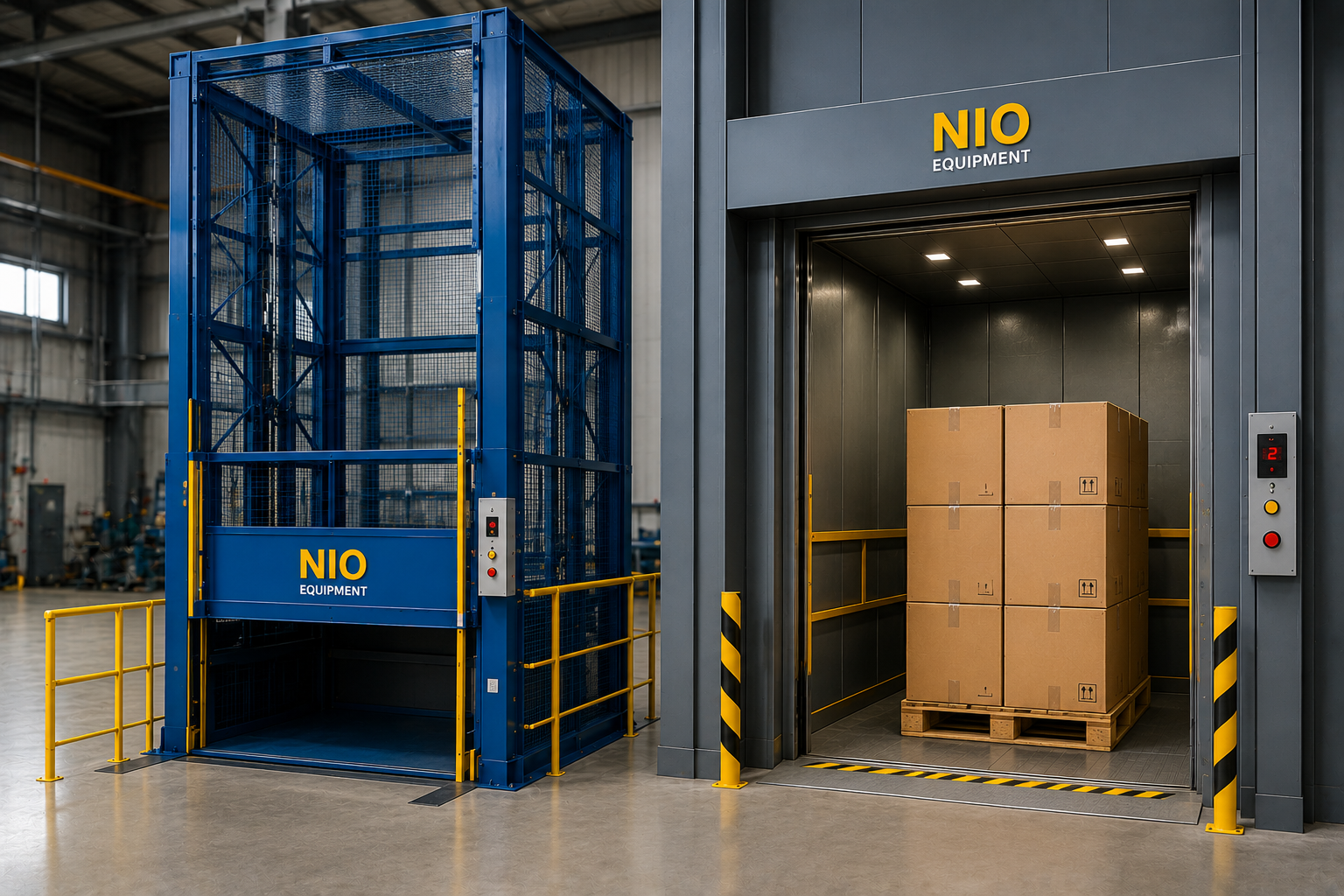
A goods lift is one of the most critical investments for any multi-storey factory or warehouse. It directly impacts your material flow efficiency, worker safety and long-term operational costs. Yet many plant managers rush this decision, choosing purely on price — only to face breakdowns, safety issues and expensive retrofits within 2-3 years.
1. Define Your Load Requirements
Start by documenting the heaviest load you will move regularly — not occasionally. A goods lift rated at 2 tonnes may seem sufficient if your average load is 1.5 tonnes, but peak loads during shift changes or batch transfers often exceed averages. Nio Equipment recommends sizing your lift at 20-30% above your regular peak load to allow for future capacity growth.
- Weigh your heaviest pallet, trolley or roll cage fully loaded
- Account for the weight of the trolley or pallet truck itself
- Consider whether operators will ride with the goods (this changes the lift classification)
- Factor in future product line changes that may increase load weights
2. Measure Travel Height and Pit Requirements
The travel height — the vertical distance between the lowest and highest stopping points — determines the hydraulic cylinder size, guide rail length and structural requirements. Buildings with more than 3 stops may need a different lift configuration than a simple 2-stop unit.
Pit depth is another critical factor. Most hydraulic goods lifts require a pit of 300-500mm, but Nio Equipment offers low-pit and zero-pit configurations for buildings where excavation is impractical. Discuss this early in the process to avoid costly civil work surprises.
3. Platform Size and Door Configuration
The platform must accommodate your largest load plus the handling equipment (pallet truck, trolley, forklift). Standard platform sizes range from 1.5m × 1.5m to 3m × 4m, but Nio Equipment manufactures custom platform sizes to match your exact requirement. Door configuration — single entry, through-type (opposite doors) or adjacent doors — depends on your floor layout and material flow direction.
4. Safety Features to Insist On
Never compromise on safety features. A well-engineered goods lift should include overload protection, emergency stop buttons at every landing, an anti-fall safety device, interlocked landing doors and a manual lowering valve for power failure scenarios. These are not premium extras — they are essential for safe daily operation.
- Overload protection with audible alarm
- Emergency stop at each landing and inside the cabin
- Anti-fall safety device (rope brake or safety gear)
- Electro-mechanical door interlocks on all landing doors
- Manual lowering valve for power failure
- Phase failure and phase reversal protection
5. Installation and After-Sales Support
A goods lift is only as good as its installation. Ensure your supplier provides on-site installation, commissioning, load testing and operator training. Nio Equipment handles end-to-end project execution — from site survey and civil drawing support to installation, testing and handover — so you have a single point of accountability.
After-sales support matters equally. Ask about warranty terms, AMC (Annual Maintenance Contract) options, spare parts availability and response time for breakdown calls. A manufacturer with local service presence will always outperform a distant supplier when your lift needs urgent attention.