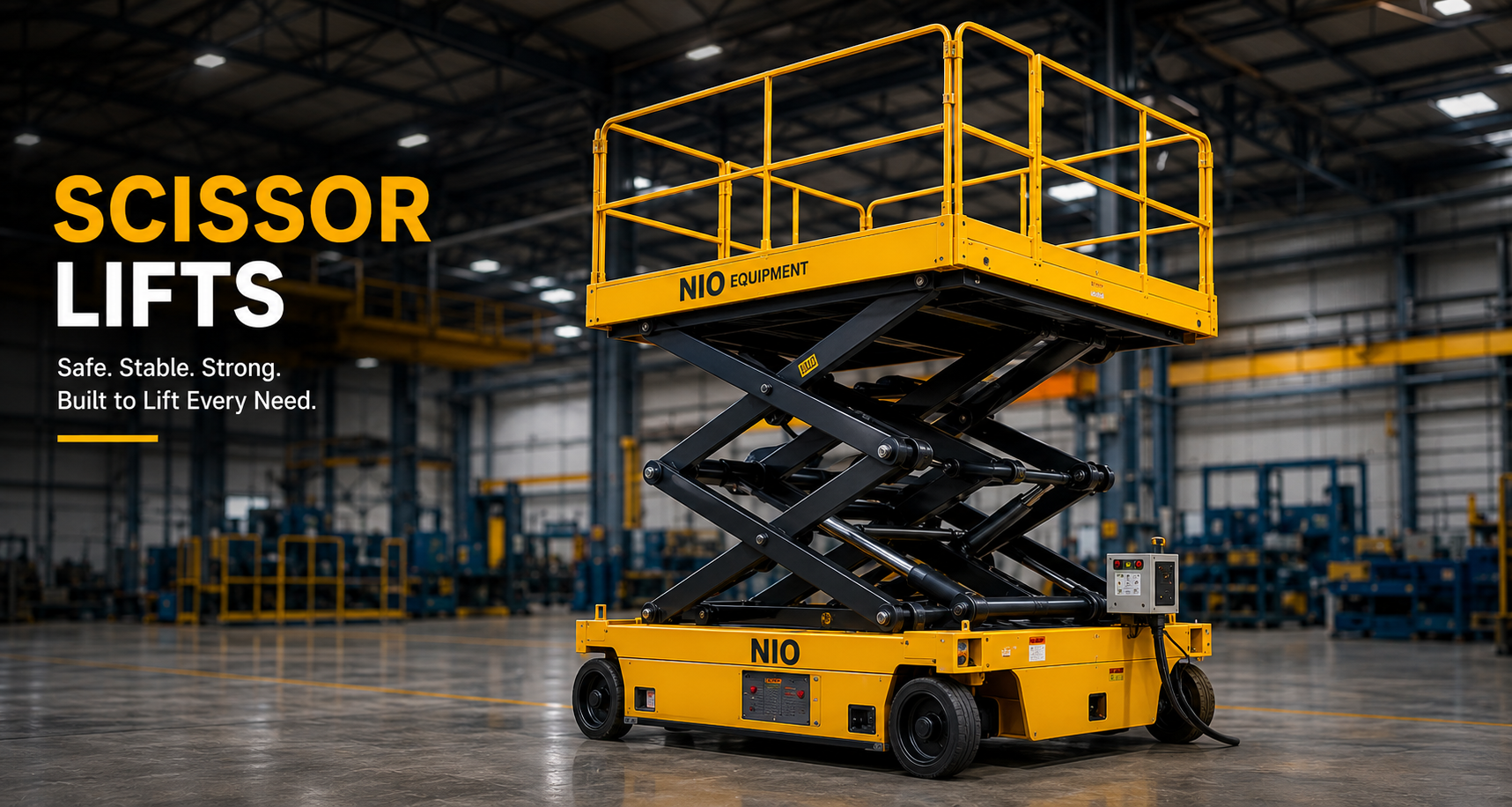
Nio Equipment Stationary Scissor Lift is a permanently positioned hydraulic lifting platform designed for dedicated industrial workstations where consistent, repeatable vertical load handling is essential. Unlike mobile lifts that move between locations, the stationary configuration is engineered to remain fixed at a specific process point anchored and integrated into the production layout for continuous duty. Platform dimensions, load capacity, lift travel, scissor geometry, hydraulic power pack, control system, and surface finish are configured to match the exact operational requirements of the installation site, workflow, and process integration needs.
| Capacity | 500 kg to 5,000 kg |
| Platform Size | 1000x1000 mm to 2000x3000 mm |
| Lift Travel | 500 mm to 3,000 mm |
| Collapsed Height | 200 mm to 600 mm |
| Lifting Speed | 0.05 to 0.15 m/s |
| Power Supply | 230V single-phase, 415V three-phase, or battery DC |
| Motor Rating | 2.2 kW to 7.5 kW |
| Scissor Arrangement | Single, double, triple, or tandem |
| Platform Surface | Chequered plate, mild steel, or stainless steel |
| Installation | Fixed stationary - floor mounted or pit mounted |
| Hydraulic System | Electro-hydraulic with dedicated power pack |
| Operating Frequency | Rated for continuous industrial duty cycles |
A Stationary Scissor Lift is a permanently fixed hydraulic lifting platform installed at a dedicated industrial workstation for continuous vertical material handling. Unlike mobile lifts that move between locations, the stationary design remains anchored at a specific process point engineered for repeatable, high-frequency load positioning within production lines, assembly cells, machine feed stations, and warehouse transfer points.
The stationary scissor lift operates on a hydraulic power system that converts fluid pressure into controlled linear mechanical force. A dedicated electro-hydraulic power pack pressurizes hydraulic oil and directs it to cylinders connected to the scissor arm linkage assembly. As the cylinders extend, the scissor mechanism expands and raises the load platform in a stable vertical path. Reversing the hydraulic flow allows controlled retraction and platform descent. Travel limit switches define the upper and lower operating range, while the hydraulic hose burst valve prevents uncontrolled descent in case of system failure.
| Alternative | Key Difference |
|---|---|
| Floor Mounted Scissor Lift | While both are surface-mounted, the Stationary Scissor Lift is specifically engineered for dedicated workstation applications with high-frequency cycling and process integration, whereas the Floor Mounted Scissor Lift serves broader general-purpose fixed-position lifting needs. |
| Pit Mounted Scissor Lift | Pit Mounted Scissor Lifts provide flush floor-level access by sitting in a concrete pit, while Stationary Scissor Lifts can be either floor-mounted or pit-mounted depending on the application. The stationary designation emphasizes permanent workstation dedication rather than installation method. |
| Mobile Scissor Lift | Mobile Scissor Lifts are designed for flexible repositioning across a facility, whereas Stationary Scissor Lifts are permanently fixed at dedicated process points for continuous-duty operation eliminating the scheduling and availability issues of shared mobile equipment. |
| Scissor Lift Table | Scissor Lift Tables are typically lighter-duty, versatile units for varied applications, while Stationary Scissor Lifts are purpose-built for heavy-duty, high-frequency operation at permanent industrial workstations with deeper process integration capabilities. |
| Hydraulic Scissor Lift | Hydraulic Scissor Lift is a broad category covering various configurations. The Stationary Scissor Lift is a specific subtype optimized for permanent installation, continuous duty, and automation integration at dedicated industrial positions. |
| Rail Mounted Scissor Lift | Rail Mounted Scissor Lifts provide linear horizontal travel along a track in addition to vertical lifting. Stationary Scissor Lifts are fixed in position without lateral movement, ideal when the process point does not change. |
Trusted by manufacturers, warehouses and industrial facilities across India for quality, reliability and after-sales excellence.
The Stationary Scissor Lift is a permanently fixed hydraulic lifting platform engineered for dedicated vertical material handling at industrial workstations. Installed at a specific process point and anchored to the factory or warehouse floor, it provides consistent, repeatable load positioning for production lines, assembly cells, machine feed stations, conveyor interfaces, and transfer points. Its fixed-position design eliminates dependence on shared mobile lifting equipment, ensuring a dedicated lift is always available at the workstation where it is needed.
Unlike general-purpose lift tables that may serve various temporary needs, the stationary configuration is purpose-built for its installed location. Load capacity, platform geometry, lift travel, scissor arrangement, control system, and environmental finish are engineered around the specific application the loads handled, the duty cycle, the adjacent equipment interfaces, and the production workflow the lift supports.
The defining characteristic of the Stationary Scissor Lift is its permanent dedication to a single process point. In production environments, workstations often require their own lifting solution rather than sharing mobile equipment across multiple locations. A dedicated stationary lift at each critical point ensures that material handling does not become a bottleneck the lift is always in position, always ready for the next cycle, and always configured for the specific loads and heights of that workstation.
This approach supports lean manufacturing principles by removing wait times associated with equipment sharing, reduces forklift traffic around process points, and provides the positional consistency needed for integration with automated systems, conveyors, and robotic cells.
A dedicated electro-hydraulic power pack drives the scissor mechanism through hydraulic cylinders. The system converts fluid pressure into controlled vertical force, raising and lowering the platform at speeds between 0.05 and 0.15 m/s. The hydraulic circuit includes flow control for smooth speed regulation, a hose burst valve for descent protection, and pressure relief for overload prevention.
Control systems range from simple push-button or foot-switch operation to fully integrated PLC automation with HMI touchscreens, wireless control, and interlocking with external conveyors and production equipment.
Because the lift remains at a fixed position, it can be precisely aligned with adjacent conveyors, machine loading points, robotic cell interfaces, packaging lines, and manual workstations. This positional certainty simplifies integration the lift platform height at each operating position is known and repeatable, enabling automated handoff between the lift and connected equipment.
Integration options include position sensors for height confirmation, interlocking signals with conveyors and machines, PLC communication for sequenced operation, and encoder feedback for precise multi-level positioning.
In facilities where mobile lifts are shared between workstations, operators frequently wait for equipment to become available. A stationary scissor lift at each critical process point eliminates this scheduling constraint. The lift is permanently assigned to the workstation, always in position and ready for the next operating cycle.
The fixed installation establishes consistent vertical handling points within the process layout. Loads are positioned repeatedly between known heights with travel limit switches and configurable controls maintaining the operating sequence. This repeatability supports coordinated transfer to machines, conveyors, and workstations.
Operators at fixed workstations handle loads at the same position throughout their shift. The stationary scissor lift adjusts the working height to reduce bending, reaching, and manual lifting at these dedicated stations helping reduce operator fatigue, minimize repetitive strain, and support compliance with workplace health and safety requirements.
The permanent fixed position and known geometry make the stationary scissor lift inherently suitable for automation integration. PLC interfaces, position sensors, load cells, and interlocking signals can be incorporated to coordinate the lift with production line equipment supporting Industry 4.0 connectivity, SCADA monitoring, and automated material flow.
By providing permanent lift points at process stations, the stationary scissor lift reduces the need for forklifts to deliver and collect loads at individual workstations. This reduces forklift traffic in production and warehouse areas, improving pedestrian safety, reducing congestion, and lowering operating costs.
Each stationary scissor lift is configured for its specific installation capacity, platform dimensions, lift travel, scissor geometry, power supply, control system, surface finish, and safety features are all engineered around the application requirements ensuring the lift is optimally suited to its workstation.
The scissor arm assembly is fabricated from heavy-duty structural steel, designed to transfer hydraulic cylinder force into controlled vertical platform movement. The structure can be arranged as single, double, triple, or tandem geometry. All pivot points use hardened pins and bushings engineered for the expected duty cycle.
Structural design considers not just nominal load capacity but also load distribution across the platform. Concentrated, offset, or varying loads are reviewed during engineering.
Available rated capacities span 500 kg to 5,000 kg, with platform dimensions from 1000x1000 mm to 2000x3000 mm and lift travel from 500 mm to 3,000 mm. Collapsed heights range from 200 mm to 600 mm depending on scissor geometry and installation type.
Requirements outside standard ranges are evaluated through project-specific engineering.
The hydraulic power pack includes an electric motor, hydraulic pump, oil reservoir, pressure relief valve, flow control, and filtration system. Motor ratings range from 2.2 kW to 7.5 kW. The power pack can be configured for single-phase 230V, three-phase 415V, or battery DC supply.
The hydraulic circuit is designed for the specific application duty cycle rating, operating temperature range, and oil volume are sized to prevent overheating during continuous operation.
The rigid base frame distributes the combined weight of the lift structure and rated load onto the installation floor. Foundation bolts or chemical anchors secure the frame to the reinforced concrete surface. For pit-mounted installations, the base frame sits within a pre-formed concrete pit with drainage provisions.
Floor loading calculations are provided during engineering to confirm the installation surface can support the operational loads.