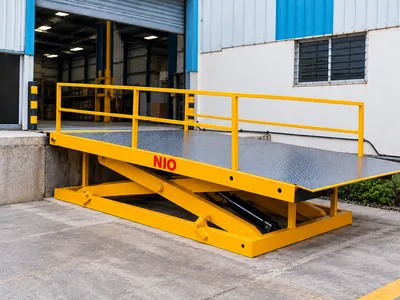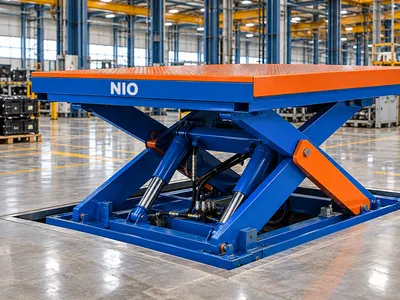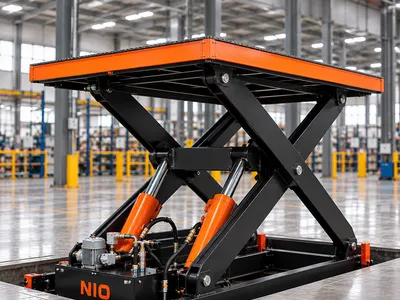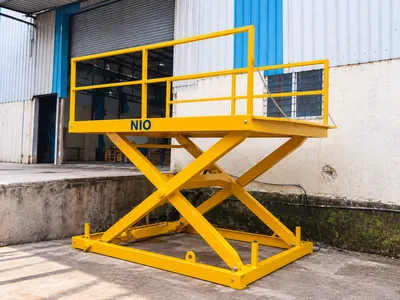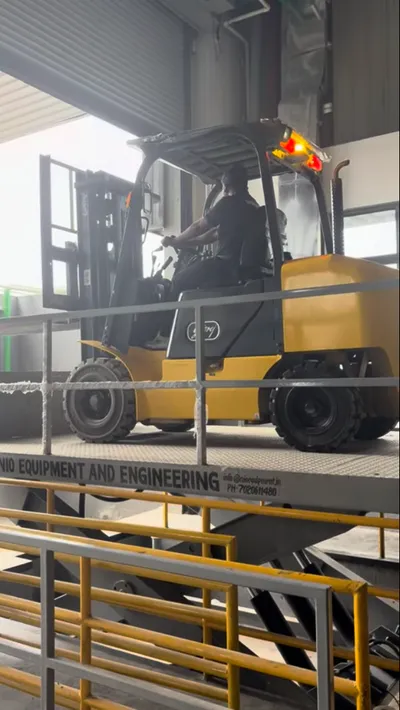
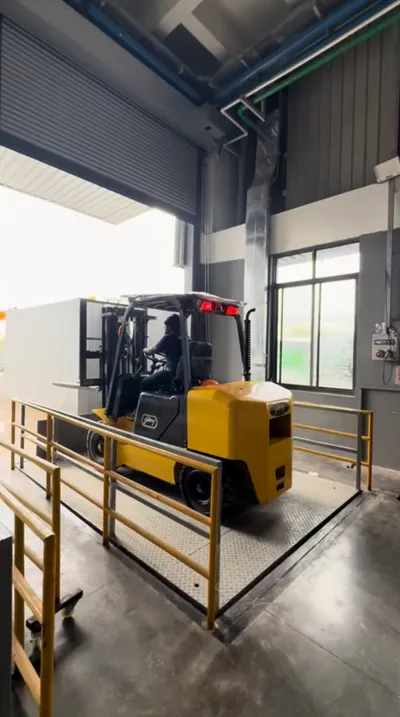
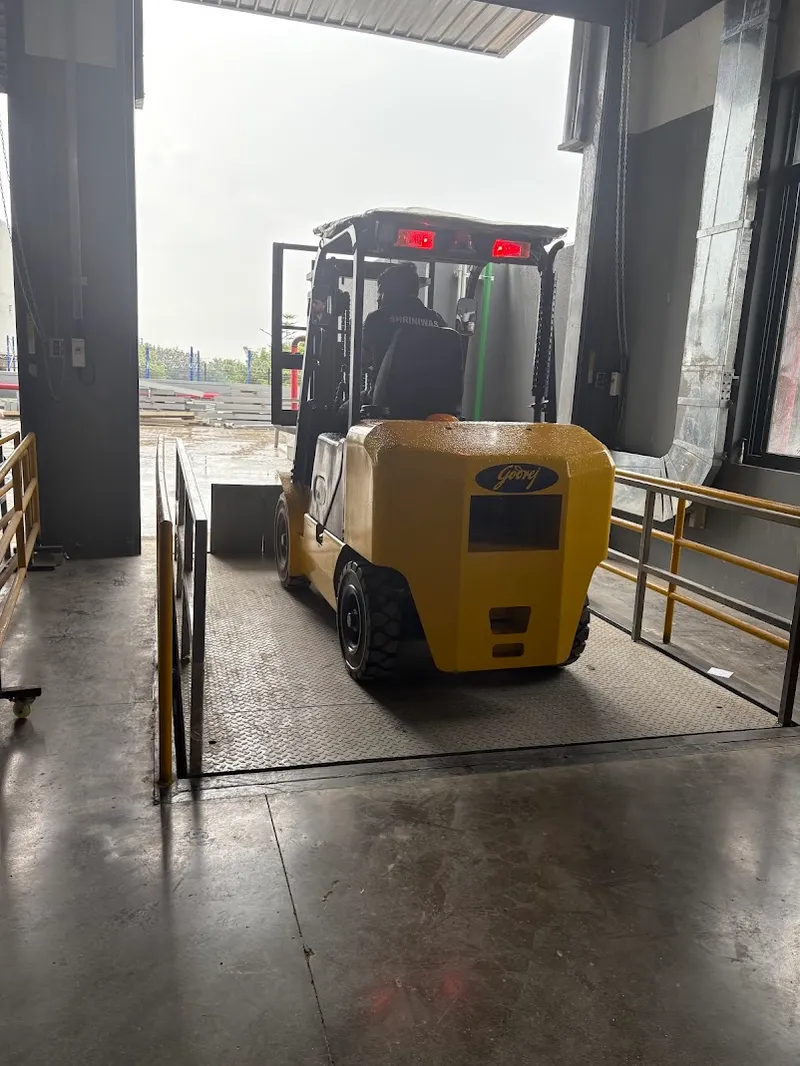
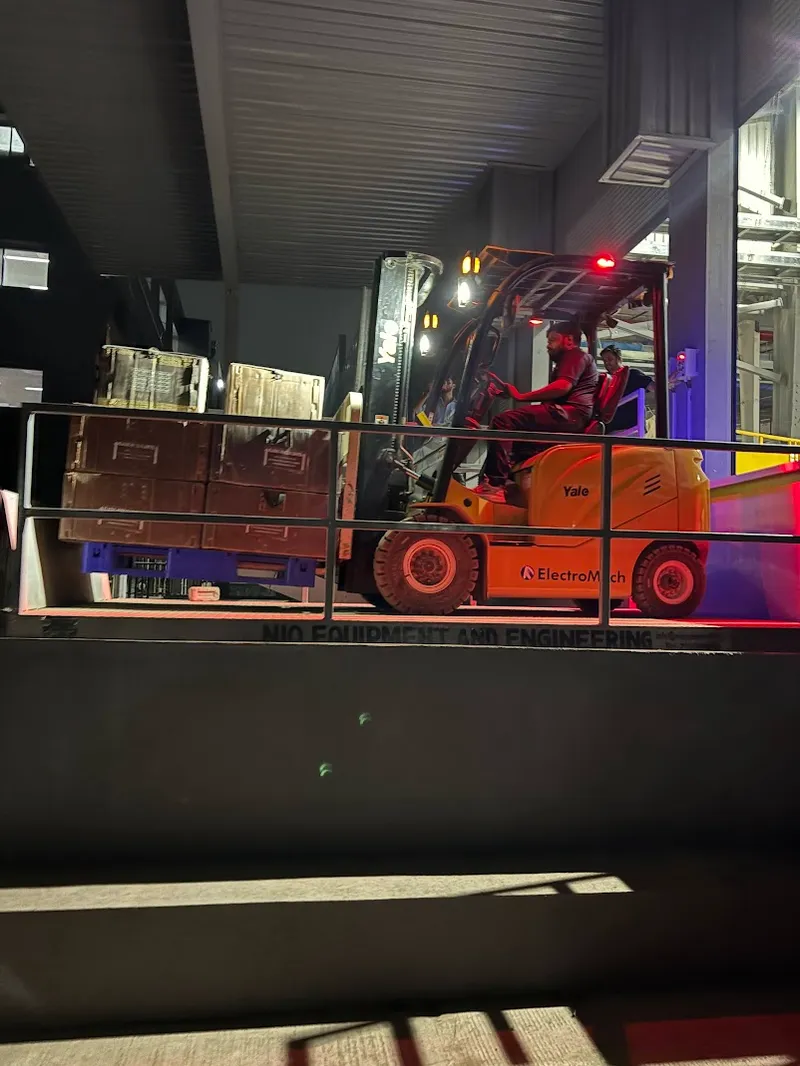
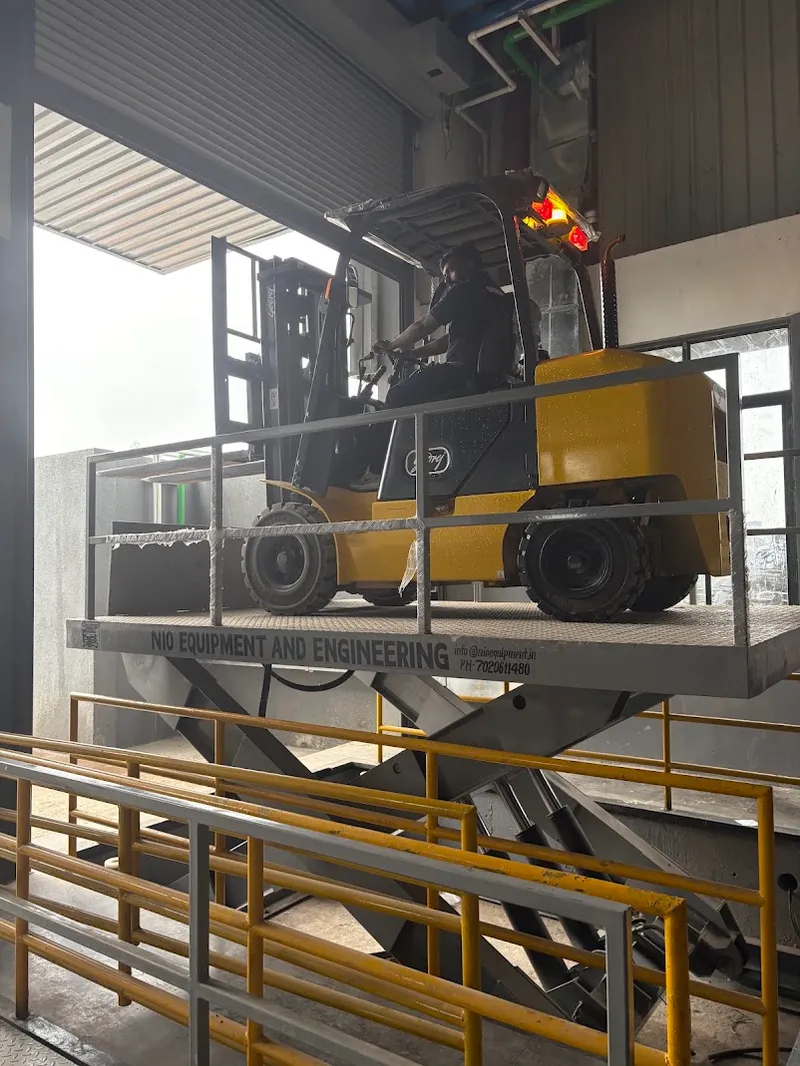
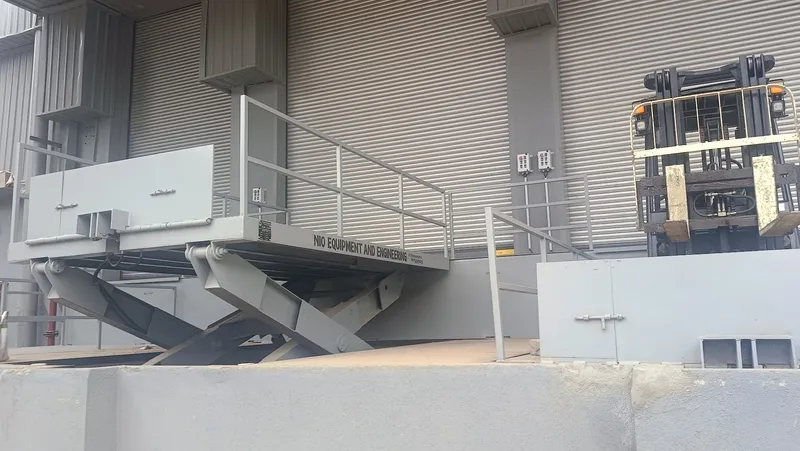
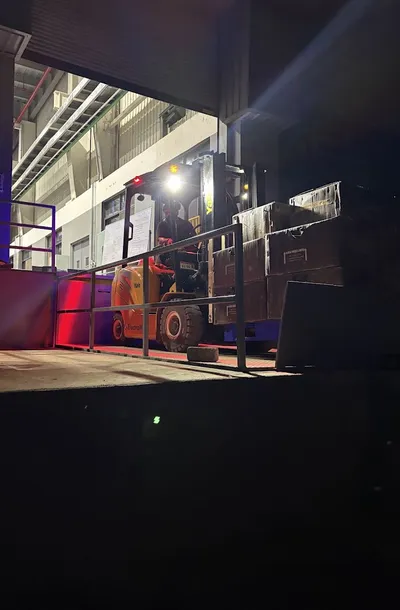
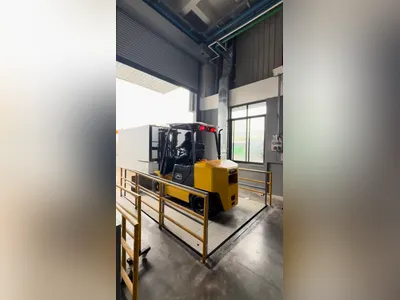
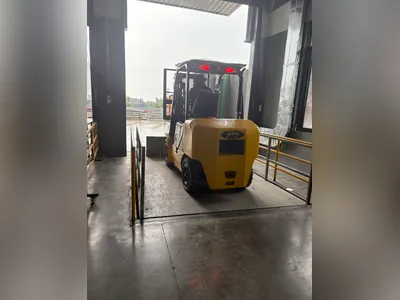
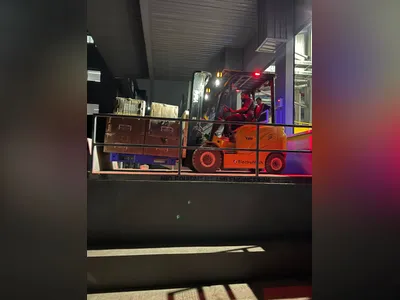
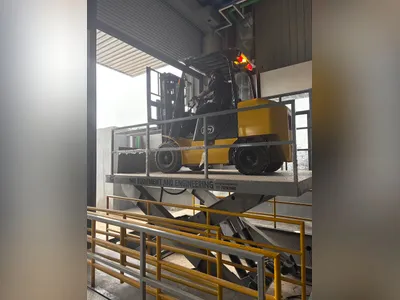
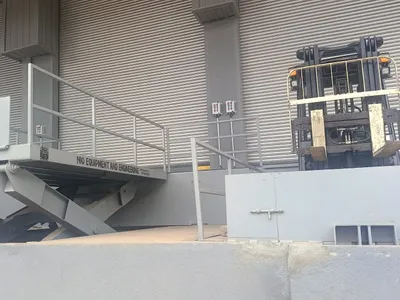
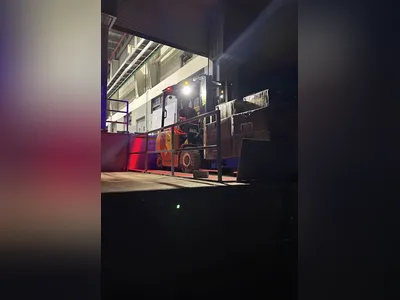
The Forklift Scissor Lift is a purpose-built drive-on platform that eliminates the height mismatch between a warehouse dock and the bed of trucks, trailers and shipping containers. Unlike conventional dock levelers limited to small height differences, this scissor lift raises or lowers the entire forklift along with its palletized load to match the exact vehicle bed height covering 800 mm to 2,000 mm of travel. SWL ratings from 5 to 10 tons account for the combined forklift plus cargo weight. The 10 mm chequered plate surface provides anti-skid traction, and tandem hydraulic cylinders deliver stable, level lifting even under eccentric loads. Standard pit-mounted installation sits flush with the dock floor; floor-mounted configurations with approach ramps are available. Safety systems include anti-rollback toe guards, overload bypass valves, burst-proof hydraulic hoses, emergency stops and constant-pressure hold-to-run controls. Nio Equipment custom-engineers each platform to the specific dock layout, vehicle fleet and cargo profile.
| Load Capacity (SWL) | 5,000 kg to 10,000 kg (forklift + cargo combined) |
| Platform Size | 2,000 mm x 2,500 mm to 3,500 mm x 6,000 mm |
| Lift Travel | 800 mm to 2,000 mm (dock-to-vehicle bridging range) |
| Collapsed Height | 400 mm to 800 mm |
| Platform Surface | 10 mm chequered plate (anti-skid, forklift-grade) |
| Safety Railings | Standard on three sides, removable dock-side railing |
| Hydraulic System | Tandem cylinder, flow-control descent, burst-proof hoses |
| Power Unit | 3-phase AC motor, 415V/50Hz, 5.5 to 11 kW |
| Lifting Speed | Loaded rise 30-60 seconds, controlled descent |
| Scissor Type | Single or tandem heavy-duty scissor pairs |
| Installation | Pit-mounted (flush with dock floor) or floor-mounted with approach ramps |
| Approach Ramps | Hinged dock lip or bolt-on ramp plates (optional) |
| Controls | Push-button pendant, constant-pressure hold-to-run |
| Safety Features | Anti-rollback toe guards, overload bypass valve, emergency stop, LED dock indicators |
| Construction | Heavy-gauge MS fabricated frame, powder-coated or hot-dip galvanized |
| Operating Temperature | 0 deg C to 50 deg C |
Forklift Scissor Lift is a heavy-duty drive-on hydraulic platform that bridges the height gap between warehouse docks and truck or container beds, allowing forklifts carrying palletized cargo to drive directly onto the platform for loading and unloading operations. SWL ratings from 5 to 10 tons account for the combined weight of the forklift plus its cargo. The platform is pit-mounted flush with the dock floor for seamless drive-on access.
The lift operates on a hydraulic scissor mechanism where a power pack delivers pressurized fluid to tandem cylinders connected to heavy-duty scissor arms. The cylinders extend the scissor arms to raise the platform vertically while maintaining a level surface even under eccentric forklift loads. Controlled lowering is achieved by regulating fluid flow through descent valves. Burst-proof hoses and overload bypass valves provide hydraulic safety throughout the travel range.
| Alternative | Key Difference |
|---|---|
| Dock Leveler | Dock levelers bridge small height gaps (100-300 mm) and support lighter loads. Forklift Scissor Lifts handle 5-10 ton combined loads across 800-2,000 mm travel for full forklift drive-on access. |
| Heavy Duty Scissor Lift | Heavy Duty Scissor Lifts position static loads in manufacturing environments. Forklift Scissor Lifts are dock-specific, handling dynamic forklift drive-on loads with dock-bridging safety features. |
| Mobile Dock Ramp | Mobile dock ramps provide fixed-angle ramp access without height adjustment. Forklift Scissor Lifts adjust to any vehicle height within their travel range and provide level platform access. |
| Dock Scissor Lift | Dock Scissor Lifts handle pallets and trolleys at lower capacities. Forklift Scissor Lifts are rated for the full weight of a loaded forklift driving on the platform. |
| Container Loading Ramp | Container loading ramps provide fixed or adjustable ramp access. Forklift Scissor Lifts provide level platform access at the exact container floor height without incline driving. |
| Pit Mounted Scissor Lift | Standard pit mounted lifts are general-purpose. Forklift Scissor Lifts are specifically engineered for forklift drive-on loads with dock-facing safety systems and dock lip options. |
Trusted by manufacturers, warehouses and industrial facilities across India for quality, reliability and after-sales excellence.
The Forklift Scissor Lift is a heavy-duty drive-on hydraulic platform designed for loading dock environments where forklifts need to transfer palletized cargo directly between warehouse docks and truck or container beds. It bridges the height gap that prevents forklifts from driving directly onto vehicles, eliminating manual re-handling at dock level and significantly reducing vehicle turnaround time.
A hydraulic power pack supplies pressurized fluid to tandem cylinders connected to a heavy-duty scissor arm assembly. As the cylinders extend, the scissor arms raise the platform vertically while maintaining a level surface even under the eccentric loads created by a forklift positioned off-centre. Controlled lowering is achieved through flow-control descent valves, and burst-proof hoses ensure safe operation throughout the full travel range.
The platform forms the controlled interface between the warehouse dock floor and vehicles of varying bed heights. The forklift drives onto the platform at dock level, the platform raises to match the specific truck or container height, and the forklift drives directly into the vehicle to deposit or collect palletized cargo. This eliminates the need for intermediate staging, manual bridging or fixed-angle ramp access.
Typical installations include covered loading bays, dispatch docks, receiving areas and container yards. The standard operating context is a level, stable industrial dock floor with suitable lighting and a trained forklift operator. Weatherproof construction with galvanized frames and stainless steel hydraulic fittings may be considered for outdoor or semi-outdoor dock environments, subject to application review.
The primary application is bridging the height difference between warehouse dock floors and truck beds of varying heights. The platform adjusts across its full 800 to 2,000 mm travel range to match any truck in the fleet, from low-bed trailers to high-floor rigid trucks, enabling the forklift to drive on at dock level and drive off directly into the truck.
For ISO shipping container operations, the platform raises to match the container floor height, allowing counterbalance forklifts to drive into 20-ft and 40-ft containers for direct pallet loading and unloading. This is critical for container stripping operations where forklifts must reach pallets at the far end of the container.
In cross-docking facilities where goods are transferred directly from inbound to outbound vehicles, the Forklift Scissor Lift enables rapid vehicle-to-vehicle transfer through the dock. The platform cycles between different vehicle heights throughout the shift, supporting high-frequency operations with minimal dwell time.
Cold chain operations require fast transfer to minimize ambient temperature exposure. The powered platform positions the forklift at the exact reefer truck height immediately, reducing the time goods spend outside temperature-controlled environments compared to manual bridging methods. Cold-rated hydraulic oil and seals can be specified for sub-zero dock environments.
High-volume dispatch bays in FMCG, e-commerce and distribution operations use the platform to maintain consistent loading speed across varying vehicle types. The platform accommodates small delivery vans through to full-size articulated trailers at the same dock bay without reconfiguration.
Docks serving a mixed vehicle fleet benefit from continuous height adjustment. A single Forklift Scissor Lift replaces the need for multiple fixed-height dock plates or ramps by providing powered positioning at any height within the travel range.
Automotive OEM and Tier 1 operations use the platform for dispatching CKD kits, engine pallets, transmission assemblies and body panel racks onto trailers and into export containers. The high SWL rating handles the concentrated weight of automotive component pallets combined with the forklift.
Steel coils, structural sections, cement bag pallets and building material loads require platforms rated for concentrated point loads. The tandem cylinder design maintains platform level stability under heavy, unevenly distributed loads typical of engineering and construction material dispatch.
The powered platform bridges the full height range between dock floor level and any truck or container bed height within 800 to 2,000 mm of travel. This eliminates the operational constraint that prevents forklifts from driving directly onto vehicles, removing the need for intermediate staging, manual bridging or fixed-angle ramp access.
By enabling direct forklift-to-vehicle access, the platform significantly reduces the time each truck spends at the dock. Cargo transfer that previously required multiple handling steps at dock level can be completed in a single drive-on, load, drive-off cycle, supporting facilities handling 50 or more trucks per day.
SWL ratings from 5 to 10 tons account for the full combined weight of the forklift and its palletized cargo. This is a fundamental difference from dock levelers and light-duty platforms that cannot support the dynamic loads of a forklift driving on and manoeuvring on the platform surface.
Direct forklift-to-vehicle transfer reduces the number of handling steps between warehouse storage and vehicle bed. Fewer handling steps mean fewer opportunities for pallet damage, product breakage, shrink-wrap compromise and cargo shift during transfer.
Each dock bay equipped with a Forklift Scissor Lift can service more vehicles per shift because the platform cycle time is predictable and the forklift approach is direct. This supports higher facility throughput without increasing the number of dock bays.
Tandem hydraulic cylinders provide synchronized lifting force across the scissor arm assembly. This arrangement maintains a level platform surface even when the forklift is positioned off-centre, which is common during drive-on approach and manoeuvring on the platform.
The standard platform surface uses 10 mm chequered mild steel plate providing industrial-grade anti-skid traction for forklift tyres. The chequered pattern maintains grip in dry, damp and dusty conditions typical of loading dock environments.
The flow-control descent valve regulates the speed of platform lowering regardless of the load on the platform. Combined with the burst-proof hydraulic hoses, this ensures controlled, predictable descent under all operating conditions.
The pendant-mounted hold-to-run control requires continuous operator input to raise or lower the platform. Releasing the control immediately stops all movement, preventing unattended platform operation and ensuring the operator maintains direct control throughout the cycle.
Toe guards installed at the platform edges prevent forklift wheels from rolling off the platform during elevated operation. These guards are sized for the tyre diameter of the specified forklift fleet and provide a physical barrier at the platform perimeter.
The optional hinged dock lip bridges the horizontal gap between the raised platform edge and the vehicle bed. It folds down to create a smooth transition surface for the forklift to drive across, compensating for the distance between the platform and the truck.
3PL and distribution centres handle diverse cargo types from multiple clients, servicing vehicles of varying heights at each dock bay. The Forklift Scissor Lift provides the height flexibility to accommodate this variety while maintaining consistent loading speed, supporting high-frequency operations with 50 or more truck movements per day.
Fast-moving consumer goods operations require rapid dock cycling during seasonal peaks and promotional campaigns. The platform supports palletized beverages, packaged foods, personal care products and household goods across dispatch and receiving operations. Its consistent cycle time helps maintain dispatch scheduling accuracy.
Cold chain operations prioritize speed to minimize temperature exposure during dock transfer. The powered platform eliminates the delays associated with manual height adjustment, reducing the time goods spend outside temperature-controlled environments. Cold-rated hydraulic systems can be specified for sub-zero environments.
Automotive OEM and Tier 1 facilities use the platform for dispatching heavy component pallets including engines, transmissions, CKD kits and body panels. The high SWL rating handles the concentrated weight of automotive components combined with counterbalance forklifts used in these facilities.
Pharmaceutical operations require controlled material flow and minimal handling steps to maintain product integrity. The platform provides direct forklift-to-vehicle transfer for palletized pharmaceuticals, API drums, medical device crates and cold chain shipments.
Steel fabricators, construction material suppliers and engineering works use the platform for dispatching heavy loads including steel coils, structural sections, machine components and tooling. The tandem cylinder design supports concentrated point loads typical of these materials.
E-commerce fulfilment centres service a wide range of vehicle types from small delivery vans to full-size trailers. The continuous height adjustment of the platform accommodates this vehicle variety at a single dock bay, supporting the rapid dispatch cycles required for same-day and next-day delivery operations.
Nio Equipment evaluates the lift around the actual dock interface, forklift fleet, vehicle mix and cargo profile rather than treating capacity as the only selection criterion. Platform geometry, travel, collapsed height, dock lip configuration and loading direction are considered together to produce a platform matched to the specific operational requirement.
Nio Equipment combines custom equipment design with in-house manufacturing capability for heavy-duty hydraulic lifting platforms. This supports coordination between structural design, hydraulic components, platform fabrication and the control arrangement, allowing buyers to discuss the complete application interface rather than sourcing disconnected equipment elements.
The Forklift Scissor Lift can be configured for load capacity from 5 to 10 tons, platform dimensions, pit or floor mounting, hinged dock lips, wheel guide channels, PLC integration, weatherproof construction and multiple control arrangements. Each configuration remains subject to engineering assessment and the intended operating conditions.
Nio Equipment provides pit civil drawings, foundation specifications, on-site installation coordination, hydraulic commissioning and safety device testing. This ensures the platform is correctly installed, commissioned and validated in the actual dock environment before handover to the operating team.
Nio Equipment provides after-sales support for equipment operating across India, including annual maintenance contracts, scheduled servicing, breakdown support and access to product-specific service guidance for hydraulic maintenance, structural inspection, control checks and safety-device testing.
Pit-mounted installation requires a reinforced concrete pit with depth matching the collapsed height of the scissor mechanism (typically 400 to 800 mm). The pit must include waterproofing membrane, drainage provision, cable conduit routing and sufficient structural capacity to support the combined dynamic load of the platform, forklift and cargo.
The dock floor and pit foundation must be assessed for structural capacity before installation. Nio Equipment provides detailed foundation specifications including concrete grade, reinforcement layout and load distribution requirements. Existing dock structures may require engineering review to confirm suitability.
The hydraulic power pack can be positioned up to 5 metres from the platform with flexible hose routing. Placement should consider maintenance access, noise proximity to operators, ventilation and protection from environmental exposure. Indoor or enclosed locations are preferred.
Standard operation requires 415V three-phase AC supply. Electrical routing from the main distribution board to the power pack location should be coordinated during the civil construction phase. Nio Equipment provides electrical interface specifications with each project.
Where pit excavation is not feasible, floor-mounted installation places the lift above dock floor level with fabricated approach ramps. This option is suited to existing facilities where the dock floor cannot be modified. The ramp gradient and length are engineered for the specific forklift fleet in use.
Installation is followed by hydraulic commissioning covering cylinder operation, valve settings, control response and safety device testing. Nio Equipment conducts commissioning on site, verifying that the platform meets the specified travel, load capacity and cycle time before handover.
Monthly checks should cover hydraulic oil level, oil condition and filter status. Hydraulic hose and fitting inspections should be conducted six-monthly, with replacement at any sign of wear, abrasion or leakage. The hydraulic power pack should be serviced according to the manufacturer schedule provided at commissioning.
Scissor arm pivot pins, bearings and roller assemblies should be inspected quarterly for wear, play and alignment. Lubrication points should be greased at the intervals specified in the maintenance manual. Any unusual noise or vibration during operation should prompt immediate inspection.
Emergency stop buttons, overload bypass valve, burst-proof hose check valves and limit switches should be function-tested annually as a minimum. Any safety device that fails to operate correctly should be repaired or replaced before the platform returns to service.
The chequered plate surface should be inspected for damage, warping or loss of anti-skid profile. Toe guard clearances and alignment should be checked to confirm they maintain the correct relationship with the platform edge for the forklift tyre size in use.
Pendant controls, junction boxes, cable connections and motor contactors should be inspected for damage, moisture ingress and secure termination. PLC-integrated systems should have their control logic verified during annual service visits.
Forklift operators should approach the platform at walking speed (maximum 5 km/h) and verify that the platform is fully lowered and stable before driving on. The operator should confirm that toe guards are in position and safety railings are engaged on all non-access sides before initiating any platform movement.
The overload bypass valve prevents the hydraulic system from lifting beyond the rated SWL. Operators should verify that the combined weight of the forklift and cargo does not exceed the platform rating before each cycle. Load capacity signage should be prominently displayed at the dock bay.
Emergency stop buttons are positioned at the platform and dock level. Activating any emergency stop immediately halts all platform movement. Operators should be trained in the location and use of all emergency stops during the commissioning training provided by Nio Equipment.
The constant-pressure hold-to-run control requires the operator to maintain continuous pressure on the raise or lower button. Releasing the button stops all movement immediately. This prevents unattended operation and ensures the operator is actively monitoring the platform throughout the cycle.
Before each shift, the operator should conduct a visual inspection covering platform surface condition, toe guard alignment, safety railing integrity, hydraulic hose condition, control pendant function, emergency stop operation and general cleanliness of the platform and pit area.
Where available, LED dock traffic lights and interlocked dock door controls prevent premature vehicle departure during elevated operations. Safety bollards at the platform perimeter provide additional physical protection. Clear dock marking and traffic flow signage should be maintained around the platform area.