
How to Choose the Right Goods Lift for Multi-Storey Factories Across India
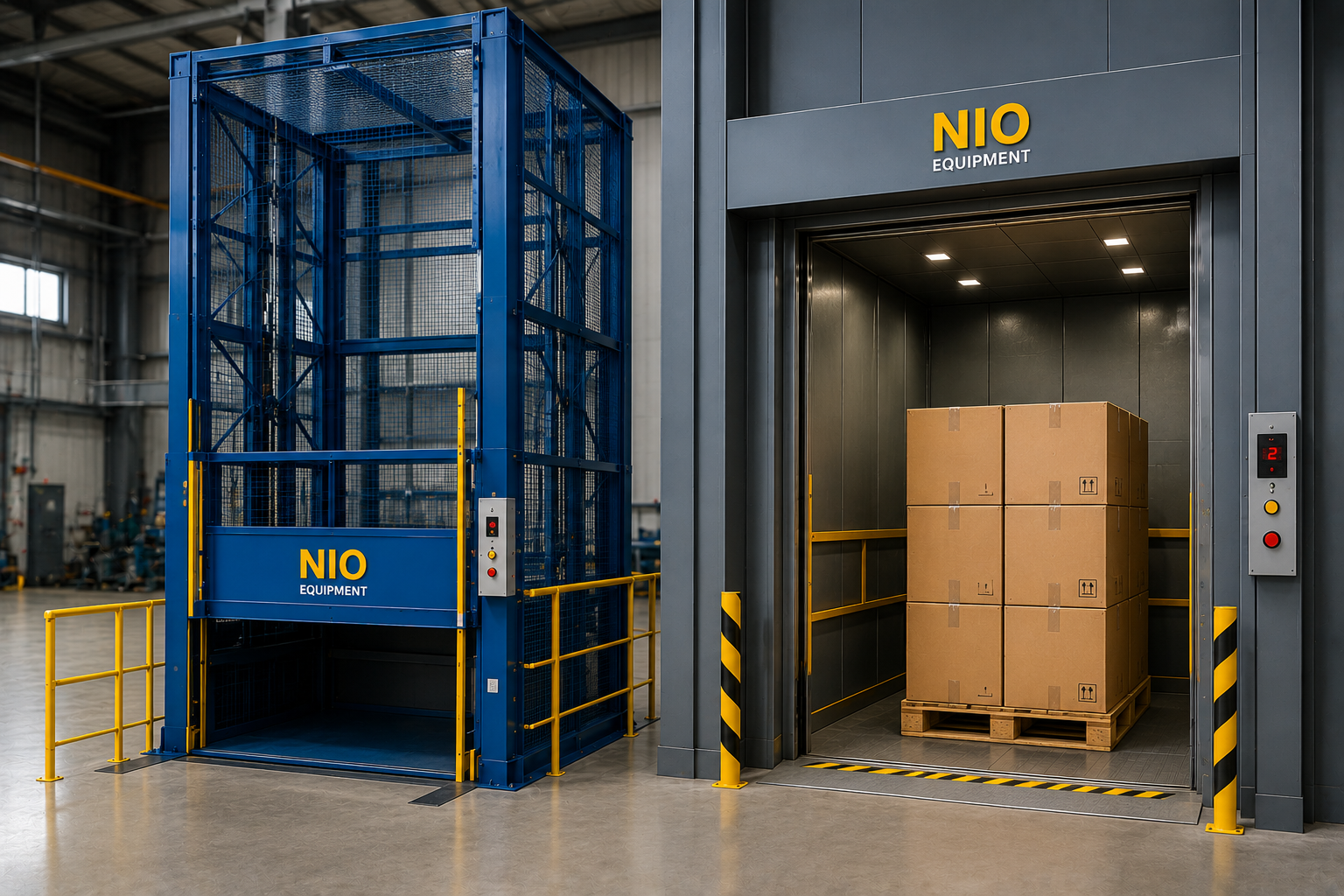
A goods lift is the most essential piece of vertical material handling equipment in any multi-storey factory. In India, where industrial land is expensive and factories build upward rather than outward, goods lifts are installed in tens of thousands of facilities — from 2-storey workshops in Ludhiana to 6-storey pharma towers in Genome Valley. But selecting the right goods lift is not a one-size-fits-all decision. Load requirements, building constraints, industry regulations and even regional climate vary significantly across India’s industrial landscape.
Regional Considerations for Goods Lift Selection
India’s industrial geography creates distinct requirements. Western India (Maharashtra, Gujarat, Goa, Rajasthan) is the most industrially dense region, with factories typically 3-4 storeys on compact MIDC/GIDC plots. Northern India (Delhi NCR, Haryana, Punjab, UP) features large-footprint industrial areas with 2-3 storey buildings. Southern India (Karnataka, Tamil Nadu, Telangana, AP, Kerala) has modern multi-storey facilities with stringent OEM and pharma audit requirements. Eastern India (West Bengal, Jharkhand, Odisha, Bihar) has heavy-industry facilities requiring high-capacity lifts for 5-10 tonne loads.
Industry-Specific Requirements
Pharmaceutical factories (Hyderabad, Ahmedabad, Baddi, Goa, Ranjangaon) need SS304 stainless steel cladding, IP65 electrics, flush-mounted doors and GMP documentation. Automotive plants (Pune, Chennai, Sanand, Manesar) need heavy-duty construction for 2-5 tonne loads with PLC integration. Textile mills (Surat, Tirupur, Ludhiana) need dust-sealed hydraulics for lint-heavy environments. Food processing plants (Punjab, Maharashtra, AP) need washdown-compatible construction with FSSAI compliance. E-commerce warehouses (Bhiwandi, Manesar, Hosur, Whitefield) need through-type door configuration for one-directional flow.
Critical Selection Parameters
- Load capacity: Weigh your heaviest load including pallet/trolley; add 25% margin. Range: 500 kg to 10 tonnes
- Travel height and stops: Measure exact floor-to-floor heights; old buildings often have non-standard dimensions
- Platform size: Accommodate your largest load plus handling equipment; allow 150-200mm clearance per side
- Door configuration: Single entry, through-type or 90-degree — determined by your material flow
- Pit depth: Standard 300-500mm; low-pit (150mm) and zero-pit options available for retrofit
- Power supply: 3-phase 415V standard; verify with your local electricity board if adding load
- Climate: Coastal regions need corrosion protection; high-humidity areas need sealed electrics; cold storage needs sub-zero rated components
New Installation vs. Retrofit
New buildings should plan the goods lift shaft during structural design — it costs 60-70% less than retrofitting later. For existing buildings, three shaft options exist: external shaft on the building face (least disruptive), internal shaft through existing openings (lowest cost), or new floor cut-outs at the optimal flow position (most flexible). An experienced manufacturer will propose options with cost-benefit analysis for each.
Pan-India Service: Why It Matters
A goods lift is a long-term investment — 15-20 years of daily operation. After-sales service, AMC availability and spare parts access are as important as the initial equipment quality. Choosing a manufacturer with pan-India service capability ensures you get timely maintenance regardless of your factory location. Nio Equipment manufactures goods lifts in Pune and provides installation and service across all 27 industrial states of India, with dedicated service teams and spare parts inventory.
Contact Nio Equipment for a free consultation. Whether you are planning a goods lift for a new facility or retrofitting one into an existing factory anywhere in India, we provide site surveys, civil engineering support, custom manufacturing, installation and lifetime service.